The Collector's Reckoning: What a Thorough Jewelry Inventory Reveals About Your Taste, Your Gaps, and Your Gold
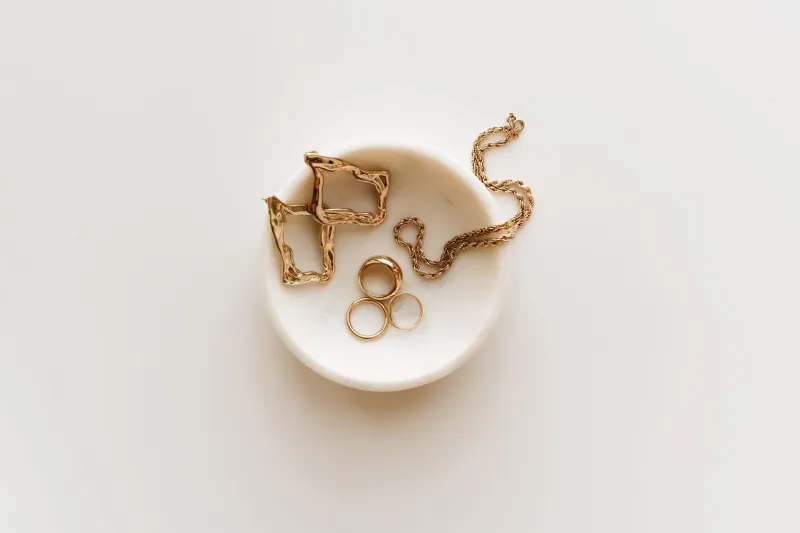
There is a particular kind of wealth that goes quietly unacknowledged. It sits in velvet-lined drawers, inside leather travel cases, tucked into the back corners of closet shelves. It is your gold collection—accumulated across years of milestones, travels, and considered purchases—and there is a reasonable chance you have not looked at all of it, truly looked, in quite some time.
For the serious collector, the idea of a jewelry audit may initially feel pedestrian, even unnecessary. But there is a compelling argument—practical, aesthetic, and financial—for knowing precisely what you own, understanding why each piece entered your collection, and assessing whether it still belongs there. The exercise is less about tidying and more about clarity.
The First Step: Gathering Everything in One Place
Begin by removing every piece of gold jewelry from every location in which it currently resides. This sounds straightforward, and yet most collectors are surprised to discover how broadly dispersed their collection has become. The everyday chain lives on the nightstand. The cocktail ring from a decade ago is still in a hotel toiletry bag tucked in a suitcase. The inherited bangle has not left its original box in years.
Spread everything across a clean, well-lit surface—a white linen cloth works well, both for contrast and to prevent scratching. Natural daylight is preferable. The goal at this stage is simply comprehensiveness. Resist the urge to make judgments before you have the full picture in front of you.
Cataloging with Intention
Once your collection is assembled, begin the documentation process. A simple spreadsheet suffices, though dedicated jewelry inventory applications exist for collectors who prefer a more structured approach. For each piece, record the following: a brief physical description, the metal type and karat, any gemstones present, the approximate age or date of acquisition, the source (purchased, gifted, inherited), and the estimated current value if known.
Photographing each item against that same white cloth creates a visual archive that proves invaluable—for insurance purposes, certainly, but also for styling reference when you are traveling light and working from memory.
This documentation step often surfaces information you had partially forgotten. A piece purchased as a splurge ten years ago may carry a maker's mark worth researching. An inherited brooch may be of a period or provenance that warrants professional appraisal. The catalog transforms a collection of objects into a collection of knowable assets.
Reading the Patterns Your Collection Has Written
With everything documented and visible, step back and observe what your collection is actually telling you. This is where the audit transcends the administrative and becomes genuinely illuminating.
Do you find yourself drawn overwhelmingly to one gold tone? A preponderance of yellow gold pieces suggests a strong instinctive preference that your daily choices may not fully honor. Are there categories conspicuously underrepresented—no substantial earrings, perhaps, or nothing that transitions from desk to dinner with ease? Gaps in a collection are not failures; they are information.
Pay attention, too, to the pieces you have never worn. Unworn jewelry is not necessarily a mistake—some pieces are aspirational, waiting for the occasion to arrive. But if a significant portion of your collection has never touched your skin, it is worth asking why. Does the piece not suit your coloring? Does it feel too precious for your actual lifestyle? Does it simply not pair well with anything else you own? These are questions worth answering honestly.
Reassessing Value: Sentimental, Aesthetic, and Financial
Not all value in a jewelry collection is monetary, and a thoughtful audit acknowledges this without conflating the categories. A gold locket of modest market value may be among the most significant pieces you own. A technically impressive diamond-set piece may hold no personal resonance whatsoever.
The goal is not to reduce your collection to its liquidation value but to understand each piece across all three dimensions: what it is worth financially, what it contributes aesthetically to your wardrobe, and what it means to you personally. When all three align, a piece earns its place without question. When one or more dimensions fall short, you have useful information for future decisions.
For pieces of uncertain financial value, this is an appropriate moment to schedule professional appraisals. The fine jewelry market evolves, and a piece appraised five years ago may carry a meaningfully different value today. Current appraisals are also essential for maintaining adequate insurance coverage—a consideration that affluent collectors sometimes underestimate until the moment it becomes urgently relevant.
Discovering Combinations You Have Never Tried
One of the more pleasurable outcomes of a full inventory is the discovery of styling possibilities that proximity alone had obscured. When every piece is visible simultaneously, the eye naturally begins composing. A vintage gold cuff you rarely wear may be precisely the counterpoint that a modern chain necklace has been waiting for. A pair of small hoop earrings, perpetually overlooked in favor of more dramatic options, may emerge as the ideal complement to a bold ring stack.
The capsule wardrobe principle—so frequently applied to clothing—translates elegantly to fine jewelry. A collection of fifteen well-chosen gold pieces can, when understood in relation to one another, generate far more than fifteen distinct looks. The audit is what makes those relationships visible.
Deciding What Stays and What Moves Forward
For pieces that no longer belong—whether because your taste has evolved, your lifestyle has shifted, or the emotional associations have faded—there are dignified options. Estate jewelry dealers and auction houses that specialize in fine gold pieces offer avenues for consignment that respect both the object and its history. Some collectors choose to repurpose gold through a skilled jeweler, transforming a piece that no longer speaks to them into something entirely new.
The decision to part with a piece should never be made hastily, which is precisely why the audit is best conducted without urgency. Observe what you have gathered, sit with it for a few days, and let the decisions surface naturally rather than forcing them.
The Ongoing Practice
A jewelry inventory is not a one-time event for the serious collector. Establishing an annual rhythm—perhaps at the turn of a new year, or ahead of a significant season—ensures that your collection remains a living, understood thing rather than an accumulation that quietly grows beyond your awareness.
The gold you have chosen to own carries your history, your instincts, and your aspirations. Knowing it fully—piece by piece, story by story—is not merely good stewardship. It is the foundation of wearing your collection with the intention it deserves.