The Art of Enough: How Discerning Collectors Are Redefining Gold Jewelry
For much of the past two decades, the dominant language of jewelry culture was one of accumulation. More chains, more stacking, more layering — the wrist and the neckline became canvases for ever-denser arrangements of metal and stone. Social media amplified this maximalist impulse, rewarding the elaborate and the abundant with attention and imitation.
But something has shifted. Quietly, deliberately, and with considerable elegance, a growing number of affluent American consumers are moving in precisely the opposite direction. They are editing, not expanding. They are choosing fewer pieces and wearing them more meaningfully. They are, in the language of contemporary luxury, practicing what might be called intentional jewelry.
This is not minimalism in the austere, self-denying sense. It is, rather, a more exacting form of connoisseurship — one that prizes quality of selection over quantity of possession, and coherence of aesthetic over novelty of acquisition.
The Quiet Rejection of Jewelry as Accumulation
The cultural conditions that produced this shift are not difficult to identify. After years of conspicuous consumption across every category of luxury goods, a segment of the affluent market began to recalibrate. Influenced in part by broader conversations about intentional living and considered consumption, and in part by a growing appreciation for the concept of the "forever piece," these consumers started asking a different question when standing in front of a jewelry case: not What else can I add? but What truly belongs?
Luxury market analysts who track high-net-worth purchasing behavior in the United States have noted this pattern with interest. "We are seeing a meaningful segment of affluent buyers move away from what I would call additive jewelry culture," observes one retail strategist who consults for fine jewelry brands. "These are consumers who already own a great deal, and who have reached a point of saturation. They are not buying less because they have less — they are buying less because they have developed a more sophisticated relationship with what they own."
This sophistication expresses itself in a particular way: through the deliberate construction of what stylists increasingly refer to as a "gold wardrobe" — a small, carefully considered collection of pieces that work in harmony with one another and with the wearer's broader aesthetic identity.
What a Curated Gold Wardrobe Actually Looks Like
The curated gold wardrobe is not a capsule in the fashion-week sense of the term. It is not a prescribed formula of five pieces or ten. It is, rather, an approach — one defined by the relationships between pieces rather than the pieces themselves.
At its foundation typically sits what stylists call the anchor piece: a single gold item of sufficient presence and quality that it can be worn alone, without supplement. This might be a substantial chain in a bold but classic link pattern, a wide cuff with architectural proportions, or a pair of earrings with enough visual weight to define an entire look. The anchor piece does the work that a maximalist arrangement achieves through volume — it commands attention without demanding company.
Built around the anchor are complementary pieces that share its tonal and material vocabulary. In a gold wardrobe, this means attending carefully to finish — the distinction between high-polish and brushed surfaces, between yellow gold and the warmer registers of a higher-karat alloy. Pieces that share a coherent material language layer beautifully when worn together and read with equal clarity when worn separately.
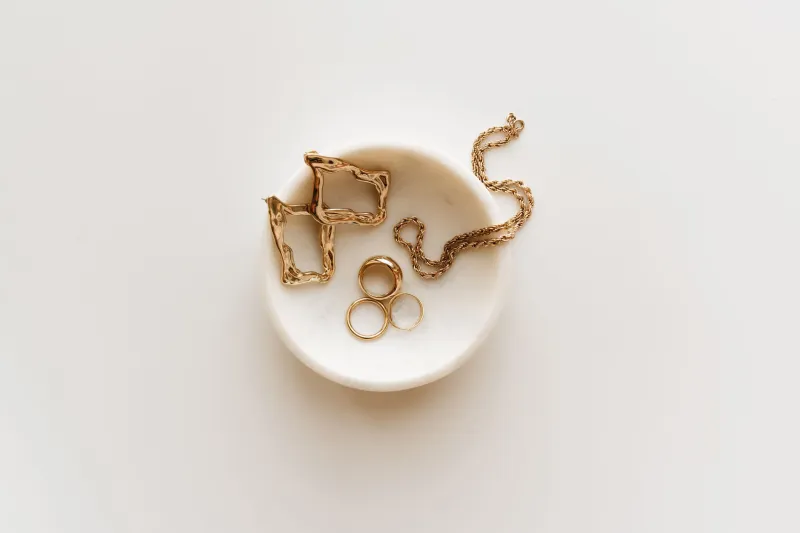
Finally, the curated wardrobe includes what might be called transitional pieces: slender chains, simple hoops, or delicate bands that serve as connective tissue — subtle enough to recede when paired with the anchor, present enough to stand alone on days when restraint is the entire point.
Expert Voices on the Shift in Luxury Consumption
The designers and stylists who work most closely with affluent American clients speak about this shift with a palpable sense of enthusiasm — as though the market has finally caught up with an aesthetic truth they have long understood.
"My clients who have the most beautiful relationships with their jewelry are not the ones with the largest collections," says a New York-based personal stylist whose clientele includes executives and public figures. "They are the ones who know exactly what they own, why they own it, and how it fits into their lives. That kind of clarity is actually quite rare, and it produces a style that is immediately recognizable as considered rather than assembled."
This observation points to something important: the curated gold wardrobe is not primarily an aesthetic strategy. It is a philosophical one. It reflects a set of values — about quality over quantity, about longevity over novelty, about the relationship between the objects we wear and the identity we project.
How to Begin Editing Your Own Collection
For those drawn to this approach but uncertain where to begin, the process of building a curated gold wardrobe starts not with acquisition but with assessment.
Begin with an honest inventory. Lay out every piece of gold jewelry you currently own and consider each one individually. Which pieces do you reach for consistently? Which have not left their cases in years? The answers reveal your actual aesthetic instincts, often more clearly than any aspirational shopping list.
Identify your anchor. If no single piece in your current collection qualifies — if nothing carries sufficient presence to wear alone with full confidence — that is your first acquisition priority. Invest in something exceptional: a piece whose craftsmanship and design will remain relevant not for a season but for decades.
Resist the impulse to fill gaps immediately. The curated wardrobe is built slowly, with patience. Each addition should be considered against the collection as a whole, evaluated for how it contributes to the overall coherence rather than simply how it appeals in isolation.
Prioritize purity and finish. In a small collection, the quality of each piece is immediately apparent. There is no volume to obscure a weak link or a mediocre finish. This is precisely why the minimalist approach demands — and rewards — a commitment to genuine quality.
The Vero Gold Philosophy, Expressed
At Vero Gold, the minimalist luxury movement is not a trend we have adapted to accommodate. It is a sensibility that has always informed our design approach. Our pieces are conceived to be worn with intention — to function as anchors, as complements, as the kind of enduring investments that make accumulation not only unnecessary but beside the point.
The shift underway in American luxury jewelry culture is, in many ways, a return to an older and wiser understanding of what fine gold is for. It is not a medium for self-expression through volume. It is a medium for self-expression through discernment — through the confidence to choose well, wear fully, and need nothing more.
That, in the end, is the art of enough.