What You Choose to Wear Reveals Who You Are Becoming: The Psychology of Gold as Personal Truth

There is a particular kind of self-knowledge that arrives not through reflection or conversation, but through action. The morning you bypass the bold cocktail ring you once adored. The afternoon you fasten a slender gold chain that, six months ago, seemed too understated to matter. These are not trivial choices. They are dispatches from a self in motion—a self that gold, uniquely among all materials, has the capacity to document.
Fine jewelry occupies a singular position in the human wardrobe. Unlike clothing, which cycles seasonally, or shoes, which wear down and are replaced, gold endures. It accumulates. It witnesses. And over time, a collection of gold pieces becomes something far more meaningful than an assortment of beautiful objects: it becomes a record of the person who chose them.
The Piece You No Longer Reach For
Consider what it means when a piece you once treasured begins to gather stillness in its box. This is not necessarily a failure of taste or a flaw in the jewelry itself. More often, it signals a quiet but significant internal shift.
Amanda, a corporate attorney based in Chicago, spent her late twenties acquiring bold, maximalist gold pieces—layered chains, oversized hoops, sculptural cuffs that commanded attention in any room. "I wanted to be seen," she recalls. "I was working very hard to establish myself, and my jewelry was part of that declaration." By her late thirties, her preferences had migrated almost entirely toward refined, minimal forms: a single signet ring, a delicate gold band, a small pendant with personal significance. The maximalist pieces are not gone. But they are resting. "They still represent something true about who I was," she says. "I just don't need to say it that loudly anymore."
This kind of migration is common among collectors who engage thoughtfully with their gold over time. The pieces that fall away are not mistakes—they are markers of a chapter that has closed, preserved in metal.
Ethics Worn on the Body
For a growing number of collectors, the evolution of their jewelry choices reflects not only personal aesthetics but deepening ethical commitments. The sourcing of gold, the labor practices of the brands they support, the environmental footprint of the industry—these considerations have become inseparable from the act of selection for many affluent American buyers.
David, a San Francisco-based entrepreneur and longtime collector, describes a turning point several years ago when he began researching the supply chains behind his most prized pieces. "I realized I knew almost nothing about where the gold had come from, who had mined it, under what conditions," he says. "That was uncomfortable knowledge to sit with." His subsequent acquisitions have been guided by transparency—he now purchases exclusively from brands that offer documented sourcing and fair-trade certifications. His older collection, pieces acquired before this awakening, remains with him. "They remind me of what I didn't yet know," he reflects. "That's worth remembering too."
The decision to prioritize ethical sourcing is, at its core, a values statement worn on the body. It transforms a bracelet or a ring into something that carries moral weight alongside aesthetic beauty—a fusion that defines the most intentional collections.
When Gold Marks a Threshold
Among the most revealing jewelry decisions are those made at moments of personal transition. Divorce, career change, the death of a parent, a hard-won recovery—these passages frequently announce themselves through gold.
Some collectors remove a piece they have worn for years, not in grief but in clarity. Others make a deliberate first purchase for themselves following a long relationship, claiming their taste and their resources as their own. Still others commission something entirely new: a design that did not exist before their particular experience brought it into being.
Lorraine, a retired professor living in New York, purchased her first significant piece of gold jewelry at sixty-two, following the death of her mother. It was a wide, textured bangle—substantial, warm, commanding in a way she had never previously permitted herself. "My mother always said fine jewelry was an indulgence," Lorraine explains. "When she was gone, I realized I had been carrying her hesitation as if it were my own." The bangle has become, she says, the piece she wears when she needs to remember her own authority. It is not a rebellion. It is an inheritance of a different kind—the inheritance of her own desires, finally claimed.
The Rejection as Revelation
Equally instructive is what the discerning collector declines. The piece tried on and returned to the display case. The gift received with genuine gratitude but never worn. The trend admired on others but instinctively avoided.
These refusals are not acts of indifference. They are acts of self-definition. To decline a beautiful piece of gold is to understand, however implicitly, that beauty alone is insufficient—that the piece must resonate with something interior, something that cannot be named but can absolutely be felt.
This intuitive discernment sharpens with time and experience. Newer collectors often describe uncertainty: the sense that they should love a piece their peers admire, the difficulty of trusting their own response over received opinion. Seasoned collectors speak of something closer to instinct—a clarity of response that arrives quickly and proves reliable. That clarity is the fruit of sustained self-knowledge, worn into being through years of choosing.
Gold as Living Archive
What distinguishes fine gold jewelry from virtually every other category of luxury consumption is its permanence as witness. A great meal is consumed. A beautiful garment eventually frays. But gold holds its form across decades, carrying with it the context of its acquisition—the person you were when you chose it, the occasion it marked, the values it expressed.
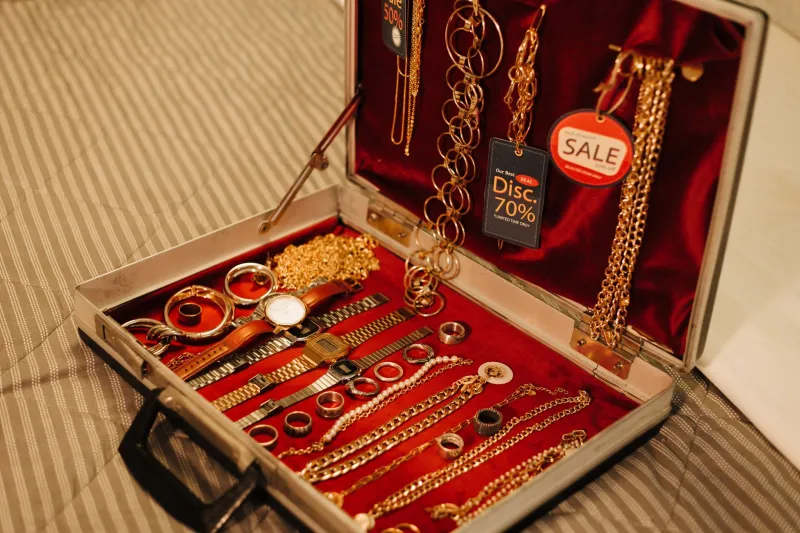
A collection assembled over a lifetime is, in this sense, a living archive. Each piece occupies a position in a larger narrative: the early acquisition that reflects ambition, the mid-career piece that speaks to refinement, the later addition that embodies hard-earned simplicity. Laid out together, they trace a life's interior geography with a precision that words rarely achieve.
At Vero Gold, we believe that the most meaningful jewelry is chosen not merely for how it looks, but for what it represents—to the world, and above all, to the wearer. The gold you select is a form of self-authorship. The collection you build over time is your most honest memoir.
Wear it with that understanding. And let it tell the truth.