Real, Rare, and Verified: A Collector's Guide to Authenticating Fine Gold Jewelry
There is a particular confidence that comes with wearing a piece of gold jewelry you know, without question, to be genuine. It settles differently at the collarbone. It catches the light with a warmth that no plated substitute can fully replicate. For collectors who have invested meaningfully in fine gold—whether through storied auction houses, heritage boutiques, or private estates—that certainty is part of the value itself.
Yet the fine jewelry market in the United States is not immune to the counterfeit economy. According to the Organization for Economic Cooperation and Development, the global trade in fake luxury goods continues to grow, with jewelry among the most frequently replicated categories. The consequences extend beyond individual financial loss: when counterfeit pieces enter circulation, they erode consumer trust, devalue authentic craftsmanship, and undermine the livelihoods of skilled artisans who have devoted their careers to the genuine article.
Authentication, then, is not merely a precaution. It is an act of stewardship.
Understanding Hallmarks: The Language of Legitimate Gold
Every piece of fine gold jewelry tells a story—and much of that story is inscribed in miniature on its surface. Hallmarks are the industry's universal shorthand for metal purity, and learning to read them is the first skill any serious collector should develop.
In the United States, gold purity is expressed in karats. A marking of 24K denotes pure gold, though pieces of this purity are rarely used in wearable jewelry due to their softness. 18K (also stamped as 750, representing 75% gold content) is the standard for high-end fine jewelry. 14K (585) remains prevalent in the American market for its durability, while 10K (417) represents the legal minimum that may be marketed as gold in this country.
European pieces frequently use millesimal fineness rather than karat designations—a stamp of 750 is the Continental equivalent of 18K. Antique and estate pieces may carry additional marks indicating the assay office that tested the metal, the maker's mark, and in some cases, the year of manufacture. British hallmarking, for instance, includes a date letter that can pinpoint production to a specific year.
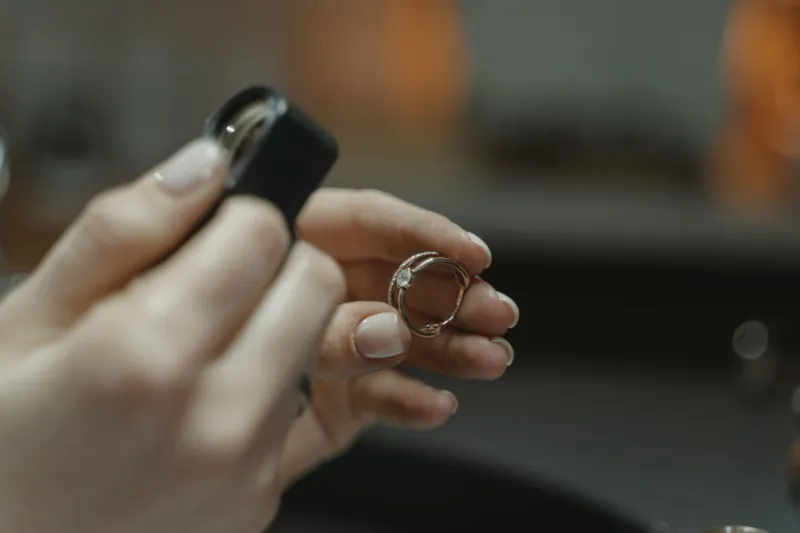
Counterfeit pieces often omit hallmarks entirely, stamp incorrect purity designations, or use markings that are slightly off—a 750 that reads as 7SO under magnification, for example. A jeweler's loupe of at least 10x magnification is a modest investment that pays dividends in clarity.
The Weight Test: What Genuine Gold Feels Like
Gold is a remarkably dense metal. This physical reality is one of the most reliable indicators of authenticity, and it is one that counterfeiters consistently struggle to replicate without dramatically increasing their production costs.
A genuine 18K gold bangle of standard proportions will feel substantively heavier than an identically sized piece fashioned from gold-plated brass or tungsten alloy. While precise weight benchmarks vary by design and dimensions, collectors who handle fine jewelry regularly develop an intuitive sense for the heft of the real thing.
For those who prefer empirical verification, a precision digital scale accurate to 0.01 grams can be cross-referenced against density calculations. Gold's density is approximately 19.3 grams per cubic centimeter for 24K, scaling downward with alloy content. A piece that measures light relative to its volume warrants closer examination.
Professional Authentication Methods Worth Knowing
Beyond what the naked eye and a scale can reveal, several professional-grade authentication methods offer a higher degree of certainty.
Acid Testing remains a widely used and cost-effective method. A small, inconspicuous area of the piece is scratched against a testing stone, and the resulting mark is exposed to nitric acid solutions of varying concentrations. Genuine gold resists acid at the level corresponding to its karat rating, while base metals or lower-purity alloys dissolve or discolor. Most reputable jewelers can perform this test in minutes.
X-Ray Fluorescence (XRF) Analysis is the preferred method for high-value pieces and estate jewelry. This non-destructive technology uses fluorescent X-rays to determine the precise elemental composition of a metal without any surface contact. Major auction houses including Christie's and Sotheby's employ XRF analysis as a standard component of their gemological due diligence.
Electronic Gold Testers measure electrical conductivity to estimate gold content. These devices are useful for quick assessments, though they are less definitive than XRF for complex alloys.
For estate purchases or significant acquisitions, engaging a Graduate Gemologist certified by the Gemological Institute of America (GIA) provides the most comprehensive and credible authentication available to private collectors.
How Counterfeiting Harms the Craft
The impact of counterfeit jewelry reaches far beyond the individual buyer who discovers, with disappointment, that a treasured piece is not what it claimed to be. The broader effect on legitimate craftspeople is considerable and underappreciated.
Artisan goldsmiths—many of whom operate small studios and pass their techniques across generations—cannot compete on price with counterfeit operations that cut every corner of material and labor. When consumers unknowingly purchase fakes at prices that seem reasonable for fine gold, they inadvertently shift market expectations in ways that pressure authentic makers to justify their pricing at every turn.
Supporting authenticated, ethically sourced gold jewelry is, in this sense, an investment in the continuation of a craft tradition that deserves to survive.
Practical Steps for the Discerning Buyer
For collectors navigating today's market—whether shopping at a Fifth Avenue boutique, a Palm Beach estate sale, or an online luxury resale platform—a few consistent practices substantially reduce risk.
Request full documentation for any significant purchase: certificates of authenticity, original receipts, appraisals from credentialed gemologists, and provenance records where available. Reputable sellers will provide these without hesitation. Reluctance to do so is itself informative.
Exercise particular caution with online resale platforms, where photographic representation can obscure quality issues that would be immediately apparent in person. When possible, request an in-person inspection or commission an independent appraisal before finalizing any transaction above a threshold meaningful to your collection.
Finally, establish a relationship with a trusted jeweler or gemologist in your area. The value of expert guidance, offered by someone who knows your collection and your standards, is difficult to overstate. Authenticity, after all, is not merely about metal content. It is about the confidence to wear what you own with complete conviction.