New Combinations, Same Collection: The Art of Layering Gold You Already Own
There is a particular kind of satisfaction that comes not from acquiring something new, but from seeing something familiar in a way you never have before. A chain you have worn singularly for years. A cuff that has always lived alone on your left wrist. A pendant that has never shared a neckline with another piece. The gold you already own holds more possibility than most collectors ever fully explore — and unlocking it requires nothing more than a willingness to reconsider what you already have.
Layering gold jewelry is, at its core, an act of creative reinterpretation. It is the jewelry equivalent of discovering that two ingredients you have always kept separate produce something extraordinary when combined. The following principles are designed to guide that discovery with intention and confidence.
Start With Inventory, Not Inspiration
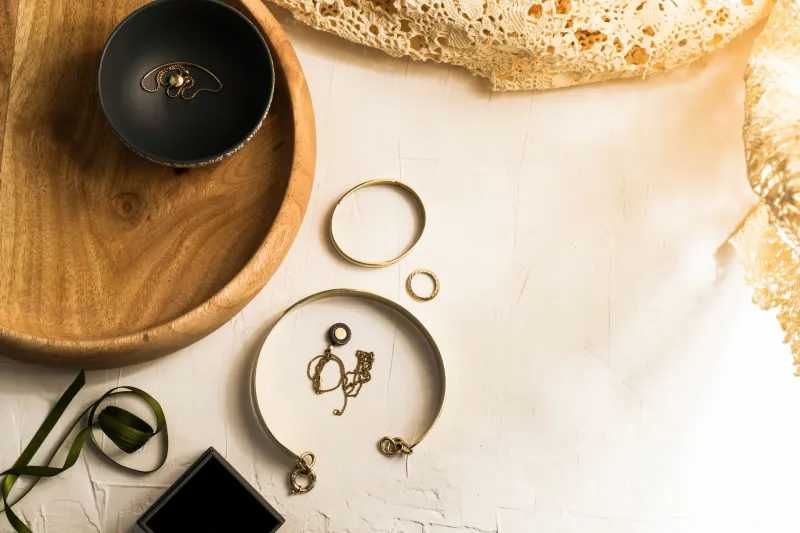
Before reaching for a styling reference or scrolling through editorial imagery, spend time with your actual collection. Lay every piece flat on a neutral surface — a white linen cloth or a velvet tray works well — and observe what you have with fresh eyes. Note the weights, the chain structures, the pendant sizes, the textures. Identify which pieces share a common gold tone and which cross between yellow, white, and rose. This physical inventory is not merely organizational; it is the first creative act.
Many collectors are surprised to discover that their existing pieces fall into natural groupings: a cluster of delicate chains suited to layering, a set of bolder links that anchor a look, a collection of rings that have never been worn together. The inventory reveals the raw material. What follows is composition.
The Neckline as a Canvas
Perhaps no layering decision is more consequential than the relationship between your neckline and your chains. The neckline of a garment frames the neck in a specific way, and the gold you layer against it should either complement or deliberately contrast that frame.
A deep V-neckline calls for pieces that echo its geometry — chains of varying lengths that descend in a graduated V formation, drawing the eye downward with intention. A classic crew neck or turtleneck, by contrast, benefits from shorter pieces that rest above the fabric line, creating a visible display rather than disappearing beneath the collar.
Off-the-shoulder and wide-neck silhouettes offer the most open canvas, allowing multiple chains of different weights to spread across the collarbone and upper chest without competing with a defined edge. This is the ideal occasion to pair a substantial collar-length piece with two or three finer chains beneath it — creating depth without visual chaos.
The rule that guides all neckline pairings: your longest chain should fall at least one to two inches below your shortest. Pieces that terminate at the same point tend to merge visually, losing the dimensional effect that makes layering so compelling.
Chain Architecture: Weight, Texture, and Negative Space
Not all chains layer well together, and understanding why is essential to avoiding combinations that feel cluttered rather than composed. The most successful layered looks are built on contrast — specifically, contrast in weight and texture.
Pairing a fine cable chain with a heavier rope or figaro creates visual tension that reads as intentional. Placing two cable chains of similar weight side by side, however, tends to produce a tangled, indistinct effect that serves neither piece. The principle is simple: let each chain occupy its own visual lane.
Texture plays an equally important role. Smooth, high-polish links reflect light in a uniform way, while hammered or twisted gold catches it differently at every angle. Combining one polished chain with one textured piece introduces a subtle complexity that elevates the overall composition without requiring additional length or weight.
Negative space — the visible skin between chains — is not empty; it is structural. Resist the impulse to fill every inch of the neckline. The pauses between pieces give the eye a place to rest and allow each element to be appreciated individually.
Wrist Stacking with Purpose
The wrist is a more forgiving canvas than the neck, largely because it is smaller and the pieces upon it are viewed in motion. This dynamism means that stacking tolerates — and even rewards — more variety than neckline layering.
Begin with an anchor piece: a cuff, a wide chain bracelet, or a bangle with substantial visual weight. Build outward from this anchor using progressively finer pieces. A bold gold cuff paired with two or three delicate chain bracelets creates a graduated effect that feels intentional rather than accidental.
Mixing closed bangles with lobster-clasp bracelets introduces both structural and textural variety, and wearing pieces on both wrists — rather than stacking everything on one — creates a more balanced, editorial quality. The asymmetry of a single stacked wrist versus a bare one can feel powerful and deliberate; the symmetry of complementary pieces on each wrist feels polished and considered. Neither approach is incorrect. The choice should reflect the occasion and the overall composition of the look.
Rings deserve mention here as well. Stacking rings across multiple fingers — including the index and middle fingers, which are often overlooked — extends the gold composition downward from the wrist and creates a unified hand aesthetic. A single substantial ring on one hand paired with a more intricate stack on the other mirrors the layered neckline principle: contrast creates interest.
When to Edit, Not Add
The most important discipline in layering is knowing when the composition is complete. A common error is to continue adding pieces in search of a more dramatic effect, when the look has already achieved its ideal balance. Step back — literally — and view the full combination from a distance before making a final decision.
If any single piece draws the eye exclusively and the others disappear, the balance is off. If the overall effect feels heavy or visually dense, remove the most recent addition rather than continuing to adjust the others. The goal is a composition in which every piece contributes without any single element dominating.
It is also worth noting that some of the most striking layered looks are built on restraint. Two perfectly chosen chains at the right lengths, or three rings distributed thoughtfully across the hand, can be more impactful than a maximalist arrangement that leaves nothing to the imagination.
The Collection as a Living Thing
A well-curated gold collection is not a static archive. It is a set of materials that evolve in meaning and application as your style develops and your life changes. The pieces you acquired at different points in your life carry different weights — sentimental, aesthetic, historical — and layering them together is a way of honoring that complexity.
The chain from a milestone birthday alongside the bangle purchased on a trip abroad alongside the inherited ring resized to fit your hand: worn together, these pieces do not simply adorn. They narrate. They make visible the accumulation of a life lived with attention to beauty and meaning.
This is the deeper logic of the remix effect. It is not merely a styling technique. It is a practice of engagement with the gold you have chosen to keep — a reminder that the collection you have already built contains more than you may yet have discovered.