Beyond the Diamond: How Sculptural Gold Is Becoming the New Language of Luxury
For the better part of a century, the diamond served as the unquestioned currency of fine jewelry. It sparkled from engagement fingers and graced the necklines of the ultra-wealthy with a clarity that seemed to communicate, without ambiguity, that its wearer had arrived. Yet something is changing — quietly, deliberately, and with the kind of conviction that marks not a passing trend but a genuine cultural recalibration.
Across the most prestigious ateliers in New York, Los Angeles, and beyond, the conversation has shifted. Gold, in its most architecturally ambitious, unapologetically sculptural form, is ascending to the apex of luxury expression. And the implications for collectors, investors, and serious jewelry enthusiasts are considerable.
The Cultural Conditions That Made This Possible
No aesthetic movement emerges in a vacuum. The renewed reverence for pure gold — unadorned by diamonds, unmediated by gemstones — reflects several converging forces in American luxury culture.
First, there is the growing appetite for authenticity among high-net-worth consumers. A generation of affluent buyers who came of age during a period of institutional skepticism has developed a preference for materials that require no embellishment to justify their value. Gold, with its millennia-long history as the world's most universally recognized store of worth, carries an intrinsic credibility that no marketing campaign can manufacture.
Second, there is the influence of contemporary art. As the boundaries between fine art and fine jewelry have dissolved — with designers trained at institutions like RISD and Parsons bringing sculptural literacy to the bench — the resulting pieces have elevated gold to the status of medium rather than mere material. The piece is no longer a setting for something else. It is the statement.
Third, and perhaps most tellingly, there is the quiet rejection of conspicuous consumption in its most obvious form. The diamond, for all its brilliance, has come to read, in certain circles, as a signifier of inherited convention rather than individual discernment. The move toward bold gold is, in part, a move toward a more considered — and more personal — definition of luxury.
What the Designers Are Saying
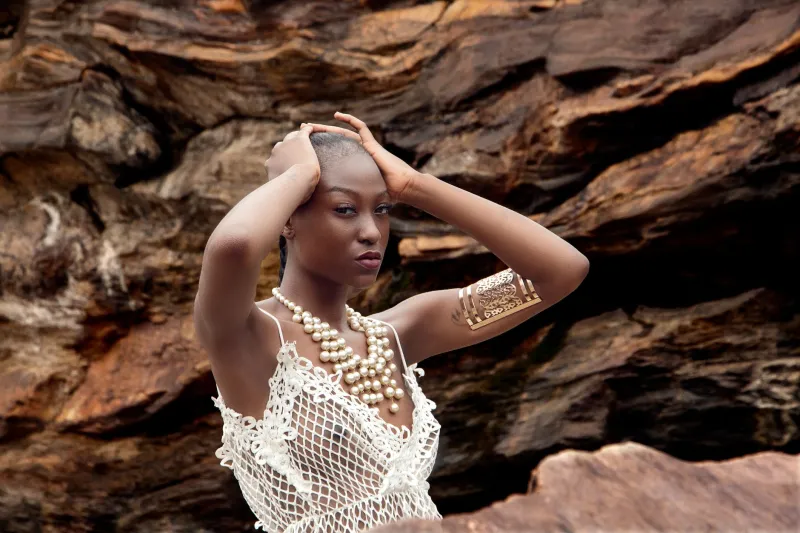
The evidence is visible in the collections emerging from the industry's most celebrated houses and independent studios alike. Architectural cuffs with sinuous, organic geometries. Torque necklaces that reference ancient Etruscan metalwork while feeling entirely contemporary. Ear sculptures that function as wearable installations rather than conventional jewelry.
Designers working in this space speak consistently about gold's unique capacity to hold form — its malleability during the making process and its permanence thereafter. Unlike a diamond, which is fundamentally passive (a beautiful object placed within a structure), gold is the structure. It bends, flows, wraps, and rises at the maker's direction. This gives the designer — and ultimately the wearer — a creative authority that gem-centric jewelry rarely affords.
The market is responding. Auction results at Christie's and Sotheby's New York have shown sustained strength in signed gold pieces from mid-century masters such as Jean Schlumberger and Elsa Peretti, whose work anticipated this moment by decades. Meanwhile, contemporary studios producing limited-edition sculptural gold are reporting extended waitlists among clients who, a few years ago, might have defaulted to a classic diamond tennis bracelet without a second thought.
The Tastemaker Effect
Cultural shifts of this magnitude rarely occur without visible advocates. The embrace of sculptural gold by a cohort of highly influential American style figures — spanning entertainment, technology, and the art world — has accelerated what might otherwise have been a slower, more gradual evolution.
When a cultural figure of significant reach chooses to attend a major public event wearing a single, commanding gold cuff rather than a diamond suite, the message is immediate and legible: restraint is power. Singularity is sophistication. The willingness to let a piece of pure metalwork carry the full weight of one's aesthetic identity signals a confidence that no amount of carats can manufacture.
This is not minimalism in the self-denying sense. The gold pieces gaining traction are often large, visually complex, and technically demanding to produce. What they share is a coherence of vision — a refusal to rely on the borrowed brilliance of stones to achieve their effect.
What This Means for the Serious Collector
For those who approach fine jewelry as both an aesthetic and financial pursuit, the sculptural gold movement presents a compelling opportunity — and a set of important considerations.
Provenance and maker identity matter enormously in this category. A boldly designed gold piece from an established atelier or a critically recognized independent designer carries a very different value trajectory than a generically executed commercial piece of similar weight. As with contemporary art, the intellectual and creative lineage of the work is inseparable from its long-term worth.
Condition and craftsmanship are equally decisive. Sculptural gold, precisely because it is not defined by the presence of stones, is evaluated entirely on the quality of its making. Surface finish, structural integrity, the precision of its forms — these are the criteria against which such pieces are judged, both aesthetically and at resale.
Finally, there is the question of wearability. The most enduring pieces in any collection are those that remain compelling across contexts — pieces that can anchor a formal occasion as readily as they elevate a considered everyday ensemble. The best sculptural gold achieves exactly this: it is neither too precious to wear nor too casual to command attention.
A New Definition of Precious
The ascendance of architectural gold does not signal the end of diamonds. Stones of exceptional quality and provenance will always hold their place among serious collectors. What this shift does signal, however, is an expanding definition of what it means for a piece of jewelry to be truly precious.
Preciousness, it turns out, is not solely a function of rarity or sparkle. It is a function of intention — of the care with which a piece was conceived, the skill with which it was executed, and the meaning with which it is worn. Gold, in its most ambitious sculptural form, embodies all three.
For the discerning collector who understands that the most powerful statement is often the most considered one, this moment in fine jewelry represents not a departure from luxury, but its most honest expression yet.