First Impressions Are Made at the Wrist: The Understated Authority of Gold Hand Jewelry
There is a moment that occurs in every introduction, in every boardroom handshake, in every candlelit dinner across a white-linen table—a moment that precedes conversation entirely. Your hands move first. They extend, gesture, reach, and rest. And in that fraction of a second, before your voice has shaped a single syllable, the gold you wear has already spoken on your behalf.
This is not a small matter. Hand jewelry—rings, bracelets, bangles, and cuffs—occupies a uniquely privileged position in the geography of personal adornment. Unlike a necklace partially concealed beneath a collar or earrings framed by hair, the pieces you place on your hands and wrists are in near-constant motion, perpetually visible, and almost magnetically noticed. They are, by any honest measure, the most scrutinized elements of your collection.
And yet, for all their visibility, hand pieces are frequently treated as afterthoughts—fillers to a look rather than its foundation. That, according to those who have studied both the psychology of jewelry and the habits of discerning collectors, is a significant miscalculation.
The Psychology of What the Hand Reveals
Research in nonverbal communication has long established that hands are among the most expressive and observed parts of the human body. We gesture to emphasize; we still ourselves to signal calm; we reach across tables to connect. This constant expressiveness makes the jewelry worn on the hands uniquely dynamic. It does not simply sit upon you—it performs alongside you.
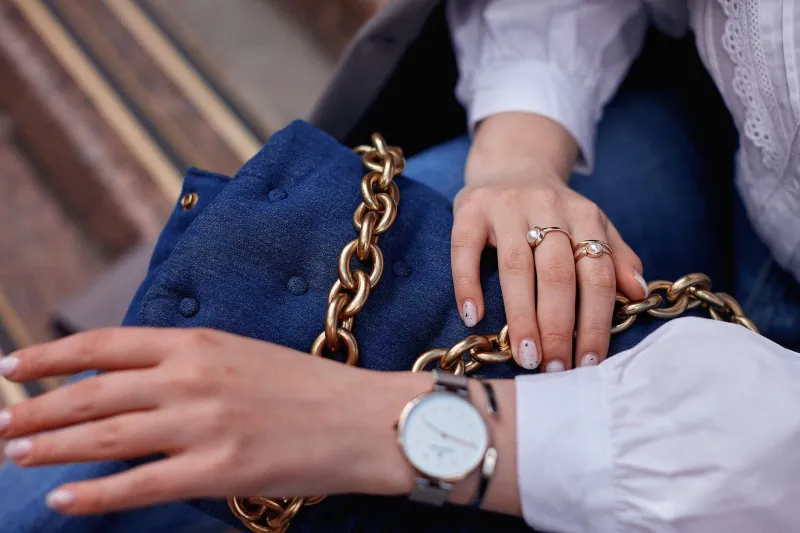
Jewelry designers who specialize in hand pieces speak frequently about this performative quality. A well-proportioned gold cuff on the wrist catches light with every gesture. A considered stack of slim gold bands draws the eye during a presentation or negotiation. A single sculptural ring becomes a conversation piece the moment a hand is extended in greeting. These are not accidents of aesthetics—they are the intended outcomes of thoughtful design.
The collector who understands this dynamic does not choose hand jewelry casually. She selects each piece with an awareness that it will be seen in motion, under varied lighting, at close range. This proximity demands a different standard of quality and craft than jewelry worn at a distance.
Why Subtlety Carries More Weight Than Scale
There is a persistent assumption in jewelry culture that impact is proportional to size—that the largest piece commands the most attention and, therefore, the most respect. Hand jewelry dismantles this assumption entirely.
A delicate 18-karat gold chain bracelet, worn alone against a bare wrist, communicates something that a dramatic collar necklace cannot: restraint. And in the vocabulary of true luxury, restraint is among the most powerful statements available. It signals that the wearer requires no amplification, that the quality of the piece speaks for itself, that excess is neither necessary nor desired.
This is particularly resonant within American professional culture, where the boundaries between personal expression and workplace propriety are constantly being negotiated. A woman who enters a Manhattan conference room wearing a single flawless gold cuff has made a declaration about her relationship to luxury that is immediately legible to those who understand the language—and entirely unobtrusive to those who do not. That dual register is precisely the point.
The Architecture of a Considered Hand
For collectors serious about the communicative potential of hand jewelry, the question is not simply which pieces to acquire, but how to compose them. The hand and wrist function as a canvas with specific proportions, and the most sophisticated collectors approach them with the same architectural thinking they might bring to a room.
Balance is the first principle. A substantial gold cuff on one wrist may call for nothing more than a single slender ring on the opposite hand—or nothing at all. The eye seeks equilibrium, and a well-composed arrangement respects that instinct without surrendering to symmetry for its own sake.
Metal tone consistency is the second consideration. While the mixing of yellow, white, and rose gold has become more widely accepted in contemporary styling, there is an enduring elegance to a hand composition that commits to a single tone. A collection of yellow gold pieces—varying in weight, texture, and finish—creates a cohesive visual narrative that reads as intentional rather than assembled.
Texture, often overlooked, is the third dimension. A brushed gold bangle alongside a high-polish band alongside a hammered cuff introduces variation that rewards close observation. These are the details that distinguish a curated hand from a merely adorned one.
Investment Value in the Details
Beyond aesthetics and psychology, there is a practical argument for prioritizing hand jewelry within a gold collection: these pieces are among the most consistently worn items in any wardrobe.
A significant necklace may be reserved for evenings and occasions. An elaborate brooch may find its moment only a handful of times per year. But a gold ring or a fine bracelet accompanies its wearer through the full texture of daily life—through morning routines and late-night dinners, through casual Saturdays and formal Mondays. This frequency of wear translates directly into value, not merely in the financial sense, though that consideration is not irrelevant, but in the deeper sense of a piece fulfilling its purpose.
Gold jewelry that is worn is gold jewelry that is alive. And pieces worn on the hands are, almost by definition, the most alive pieces in any collection.
From an investment standpoint, high-quality gold hand pieces from respected makers also tend to hold their value with notable reliability. The enduring demand for well-crafted rings and bracelets—across generations and across market cycles—reflects their status as both personal objects and portable stores of wealth. A collector who builds her hand jewelry with the same rigor she applies to her broader portfolio is not indulging in sentiment; she is exercising sound judgment.
The Intentional Collector's Approach
To wear gold on the hands with intention is to accept that you are, in some measure, always communicating. Every gesture carries your collection with it. Every introduction offers your wrists and fingers as a form of autobiography.
This need not feel like pressure. For those who approach jewelry as a language rather than a decoration, it is, in fact, a privilege—the opportunity to say something true and considered about who you are before the conversation has even begun.
The most accomplished collectors understand this instinctively. They do not fill their hands with gold for the sake of filling them. They select carefully, wear deliberately, and allow the pieces they have chosen to do the quiet, powerful work that fine gold has always been capable of doing.
Your hands move through the world ahead of you. The question worth asking is: what are they saying?