When the Gold You Love Doesn't Match the Life You've Built

There is a particular kind of tension that lives inside a jewelry box—one that has nothing to do with value, craftsmanship, or rarity. It is the tension between a piece that carries profound meaning and a wardrobe that has moved, over time, in an entirely different direction. A grandmother's wide Byzantine-link bracelet. A gift from a former partner, given during a period of life that no longer resembles the present. A bold cocktail ring acquired during a maximalist phase, now coexisting awkwardly with a pared-down, architectural closet.
This is the signature piece paradox: the gold that matters most is not always the gold that fits.
For serious collectors and casual enthusiasts alike, this tension is more common than it is discussed. The fashion conversation tends to celebrate coherence—the curated aesthetic, the intentional wardrobe, the unified visual identity. What it rarely addresses is what to do when a piece you cannot imagine parting with simply does not belong in the life you are currently living.
Why Meaning and Aesthetic So Rarely Align
Personal style is a living thing. It shifts with career, geography, age, and the quieter evolutions that accumulate over a lifetime. A woman who dressed in layered bohemian gold through her thirties may find herself drawn to clean, minimal lines in her forties. A man who received a heavy, ornate signet ring as a college graduation gift may have grown into a preference for sleek, understated accessories.
Meanwhile, the emotional weight of a piece does not evolve on the same schedule as taste. Inherited jewelry in particular carries a kind of permanence that style simply cannot override. The gold your mother wore every day of your childhood does not become less significant because it reads as baroque against your current minimalist wardrobe. The tension between those two truths—this matters deeply and this does not feel like me—is entirely legitimate, and it deserves a more thoughtful response than either forced wearing or guilty storage.
The Psychology of Wearing Someone Else's Aesthetic
When a piece arrives through inheritance or as a meaningful gift, it carries the imprint of another person's sensibility. Wearing it can feel like an act of ventriloquism—as though you are temporarily inhabiting someone else's style rather than expressing your own. For some, this is part of the appeal. There is something quietly moving about wearing your father's cufflinks to a significant occasion, even if you would never have chosen them yourself.
For others, the dissonance is harder to reconcile. The piece feels conspicuous in a way that undermines confidence rather than enhancing it. And confidence, it should be noted, is not incidental to jewelry—it is foundational. A piece worn with ambivalence rarely reads as intentional, regardless of its provenance or quality.
Psychologists who study object attachment note that the significance we assign to heirlooms is rarely about the object itself—it is about the relationship it represents. This distinction matters, because it means that honoring the piece does not necessarily require wearing it.
Styling Strategies for the Aesthetically Mismatched
For those who wish to integrate a beloved but stylistically incongruous piece into regular rotation, there are approaches worth considering.
Anchor it with restraint. A heavy or ornate piece tends to read as more intentional when everything surrounding it is simplified. If your grandmother's wide gold cuff is more elaborate than your current aesthetic, wear it as the sole accessory—no rings, no necklace, no competing layers. The piece becomes a deliberate focal point rather than a clash.
Reframe the occasion. Some pieces are not everyday jewelry and were never meant to be. Rather than forcing a bold inherited ring into a Tuesday morning meeting, reserve it for occasions that match its weight—a significant dinner, a milestone celebration, a moment that calls for something beyond the ordinary. This approach honors both the piece and the context.
Consider the conversation it starts. A piece that falls outside your aesthetic often invites exactly the kind of exchange that connects you to its story. Wearing your aunt's art deco brooch to a gathering where you might be asked about it is not an aesthetic compromise—it is an opportunity to carry her presence into a room she never entered.
Work with a jeweler on subtle adaptation. In some cases, a piece can be gently modified to feel more current without erasing its original character. A chain can be shortened. A clasp can be updated. A setting can be refined. These are not acts of erasure—they are acts of continuation, allowing a piece to live in the present without being frozen in the past.
When Rest Is the Right Answer
Not every piece needs to be worn to be honored. This is perhaps the most liberating truth available to collectors who carry the weight of meaningful gold they cannot comfortably integrate.
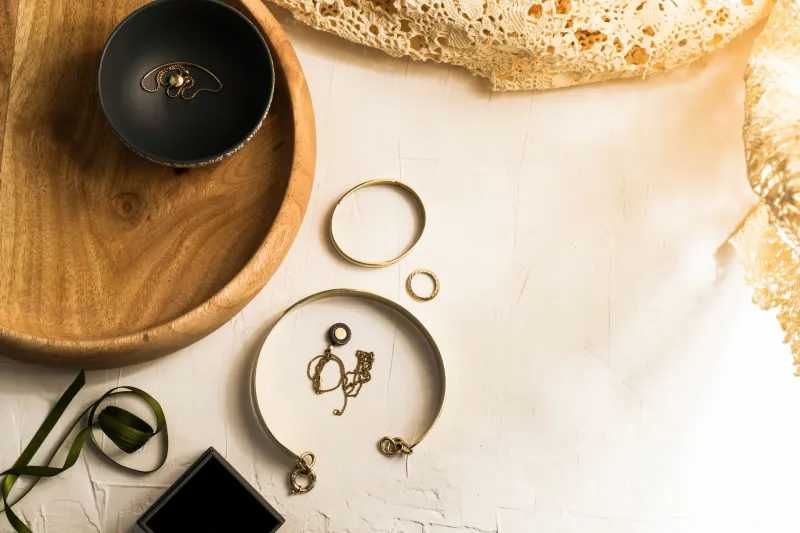
A piece can be displayed rather than stored—placed on a tray, a stand, or within a glass case where it remains visible and present without requiring daily negotiation. It can be documented through photography, its story recorded for those who will inherit it next. It can be worn once a year, on an occasion that connects directly to the person or moment it represents, and that singular wearing can carry more meaning than a hundred ambivalent appearances.
The cultural pressure to wear everything you own—to justify possession through use—is worth examining critically. Fine gold jewelry is not a fast-fashion purchase that depreciates in a drawer. It is an object of lasting value, both financial and emotional, and its relationship to time operates differently than most possessions. Resting a piece is not neglect. It is, in many cases, a form of respect.
Holding Two Truths at Once
The most sophisticated collectors tend to have made peace with a particular duality: that a piece can be deeply important and rarely worn, and that neither fact diminishes the other. The gold that sits in careful storage between significant occasions is not wasted. It is waiting—for the right moment, the right mood, the right version of you that may yet emerge.
Personal style, after all, is not a fixed destination. The minimalist wardrobe of today may soften into something more expressive in five years. The maximalist collector who has quieted her aesthetic may find her way back to bold layering. Gold, by its nature, is patient. It does not require justification.
What it does require—what every meaningful piece deserves—is the acknowledgment that it exists for reasons larger than trend. When the gold you love does not match the life you have built, the answer is rarely to force the fit or abandon the piece. It is to hold both truths with the same care you would extend to any significant relationship: honestly, thoughtfully, and without the expectation of perfect resolution.